Why learn with Language Threshold
A word becomes yours
when you can use it.
See it. Hear it. Say it. Type it. Handwrite it. Then bring it into a conversation—with feedback that helps you try again.
Start with what you need ↓doler
to hurtYour purpose comes first
Learn the language
for the life you lead.
The conversation you need gives the words a reason to matter. Start with your work, your role, or the situation you are preparing for.
Your clinical role
Begin with patient greetings, questions, and the conversations around your specialty.
Explore →Your next mission
Prepare around your role, destination, departure date, and the people working beside you.
Explore →Your team
Practice language for colleagues and daily handoffs, with assignments and progress reporting.
Explore →The contact points
Meet the same word
in more than one way.
A word has a look, a sound, a meaning, and a use. Our practice gives you different ways to connect with it, recall it, and return to what needs another pass.
See it.
Give the word a place.
Read the word beside its meaning, then meet it in a sentence. Connect the spelling to something you can picture and a situation you recognize.
Hear it.
Connect the letters to the sound.
Listen to the word and the phrase around it. Return to the parts you need to hear again, so the written word becomes something you can recognize in speech.
Say it.
Put the word in your own voice.
Speak it aloud. Try the phrase, listen again, and have another go. Begin using your voice before you need the words in a real conversation.
Type it.
Bring it back from memory.
Look away from the answer and type the word or phrase. Compare your response, notice what needs attention, and try again.
Handwrite it.
Make the letters yourself.
Write the word by hand on the practice pad. Take time with its shape, spelling, and accents, then compare your writing with the example.
Use it.
Give the word a job.
Put the words together in a conversation. Ask a question, respond to the other person, and practice saying what you mean.
See how feedback fits →These are contact points, not a rigid checklist. Use the practice you need and come back to the parts that challenge you.
From practice to conversation
Say something.
Get feedback.
Try it again.
Practice with an AI conversation partner in the context of your lesson. Respond in your own words, work with feedback on your response, and try a clearer way to express yourself.
The aim is to move beyond recognizing the answer: listen to a reply, ask for clarification, and keep the conversation going.
¿Dónde le duele?
Where does it hurt?
An illustrative phrase. Open the lesson to explore the actual activities and feedback.AI conversation and feedback need an internet connection. Feedback is generated by AI and can make mistakes.
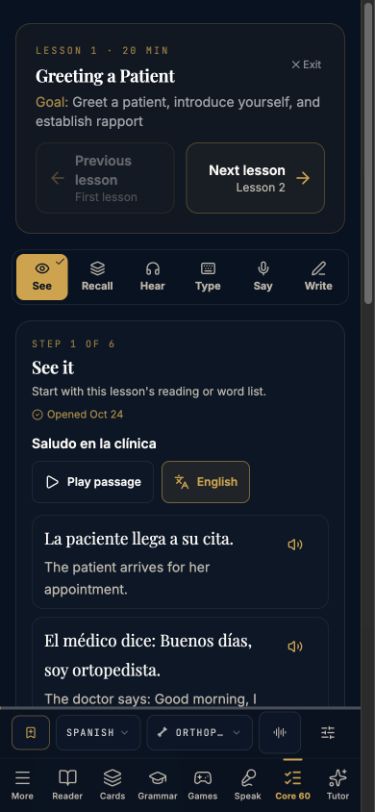
Tap the screen to open the lesson.
Start with your next conversation
Your topics.
Your words.
Your way into conversation.
Choose a topic that matters to you. Meet the words, practice them, and give them a place in a conversation.
Language practice supports communication alongside qualified interpreters and local care teams. It does not establish clinical competence or interpreter qualification.